

By linking industries so that one company’s waste becomes another’s resource, the EU-funded SYMBA project is creating a replicable methodology, digital tools and policy guidance to accelerate greener, more efficient production across Europe. We speak with Antonietta Pizza, Project Coordinator of SYMBA and Head of EU Projects Unit at ENCO, about how the project is helping to shape the foundations of Europe’s circular bioeconomy.
At the heart of Europe’s green transition lies a simple but potentially transformative idea: what if the waste from one industry could become the raw material for another? This is the principle of industrial symbiosis – a model of collaboration that turns by-products, energy and other materials into shared resources. It is a powerful way to reduce waste, cut emissions and strengthen local economies by connecting companies that might never otherwise interact.
Within the bioeconomy, the potential of this approach is particularly strong and there have been several efforts to connect companies more effectively in recent years with mixed outcomes. Many bio-based sectors generate organic residues and side streams that can be valorised elsewhere, but opportunities are often lost due to regulatory, or financial barriers or a lack of overall awareness of what’s available where. The SYMBA project is tackling this head-on, creating practical tools and policy guidance to help regions and industries apply industrial symbiosis as a driver of the circular bioeconomy.
“Industrial symbiosis is a collaborative approach where traditionally separate industries and organisations work together to achieve a collective competitive advantage,” explains Antonietta Pizza. “It operates on the principle that waste equals food within an ecosystem.”
Although often used alongside the term circular economy, Pizza stresses that the two concepts are distinct. “The circular economy is the overarching vision at the macro level, while industrial symbiosis is the operational strategy that makes it happen,” she says. “When industries use an industrial symbiosis approach, they are concretely implementing circular economy principles through the physical exchange of materials, energy, water and bioproducts among different actors.”
Industrial symbiosis relies on these connections. It requires companies to act not in isolation but as part of a network, where the by-products of one process become valuable inputs for another. “Industries should work as clusters or networks, interconnecting their ecosystems and maximising efficiencies across the group rather than within a single company,” Pizza continues. “It’s based on four key principles: reduce, reuse, recycle and recover.”
Within the bioeconomy, the relevance is immediate. Many bio-based industries already produce side streams rich in nutrients, fibres, or chemical precursors that could be re-used elsewhere. Yet the absence of systematic frameworks and policy support often means these opportunities are missed. SYMBA aims to close that gap.
Building a practical methodology
Launched in January 2024, SYMBA – short for Securing local supplY chains via the development of new Methods to assess the circularity and symbiosis of the Bio-bAsed industrial ecosystem enhancing the EU competitiveness and resource independence – is a 36-month Coordination and Support Action involving nine partners from five countries. Its goal is to design a methodology that helps industries in bio-based sectors adopt and benefit from industrial symbiosis.
“We are now in month 22 and we have already reached several milestones,” Pizza says. “Even during the proposal phase, we identified a lack of European, national and regional legislation specifically addressing industrial symbiosis. There are rules under the Waste Framework Directive and various circular economy or bioeconomy policies, but nothing directly governing how to implement industrial symbiosis.”
That absence of guidance is compounded by financial and structural barriers. “Local actors and industries often lack funding,” she explains. “Governments and policymakers should define relevant financial support mechanisms, because without them it’s difficult for industries to invest in the infrastructure needed to exchange waste or by-products.”
For SYMBA, this has shaped the project’s approach from the start.
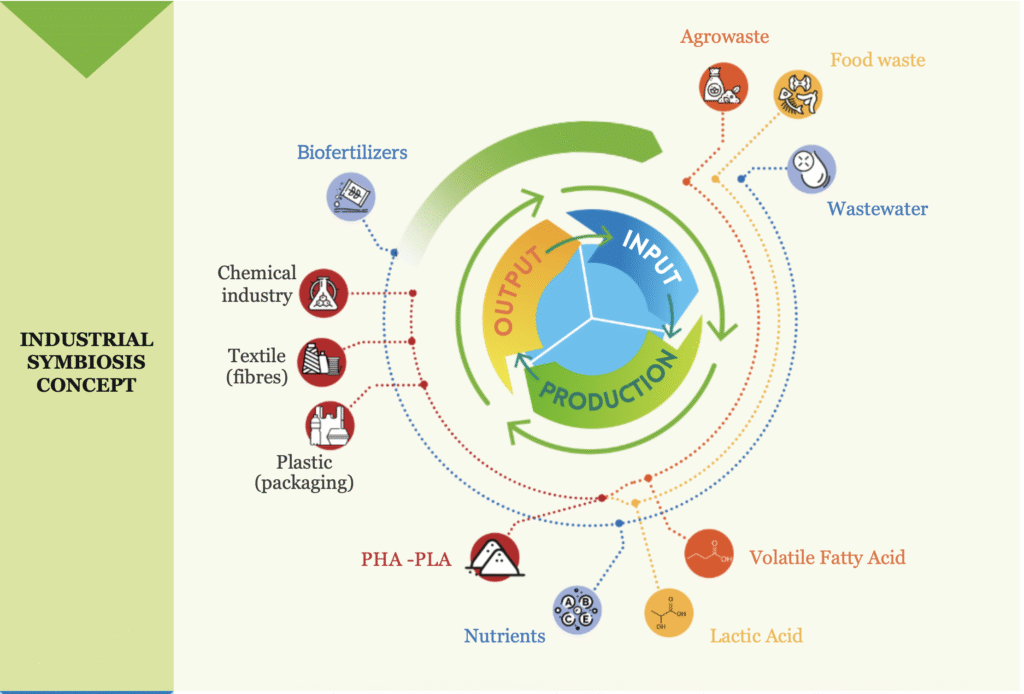
Four European regions have been selected to take part in the co-creation process, providing real-world feedback to ensure the methodology and tools reflect the realities of local economies. “These regions are external players supporting us in defining SYMBA’s most relevant results,” Pizza says. “Through a co-creation process, we collect their insights on technical, economic and regulatory barriers and adapt our work accordingly.”

Project Title:
SYMBA – Securing local supplY chains via the development of new Methods to assess the circularity and symbiosis of the Bio-bAsed industrial ecosystem enhancing the EU competitiveness and resource independence
Project Objective:
The SYMBA project is developing a new industrial symbiosis method tailored to local bio-based ecosystems. Using an AI-driven database, SYMBA will suggest innovative zero-waste processes, strengthening local supply chains, sharing benefits fairly among stakeholders, and increasing the economic value of final products.
Project Duration and Timing:
36 months: 1 January 2024 – 31 December 2026
Project Funding:
European Research Executive Agency (REA)

Project Partners:
SYMBA is a Coordinated Support Action with 9 partners from five countries:
ENCO
CIRCE
CENTEXBEL
CLIMATE KIC
BIO BASE EUROPE PILIOT PLANT
AIMPLAS
NOVAMONT
CETAQUA
ICLEI
Policy frameworks
The regulatory dimension is central to SYMBA’s mission. Without clearer rules and consistent guidance, industries are often hesitant to market products made using another sector’s residues or wastes – even when those products are safe, sustainable and economically attractive.
“If an industry starts producing goods through an industrial symbiosis approach, it means, in principle, that we are buying products made from another industry’s waste,” says Pizza. “It’s really important to communicate and educate consumers on why this approach matters – for the economy, for society, and especially for the environment.”
To address these issues, SYMBA is developing a series of policy briefs that summarise the challenges regions face and propose solutions. “Our first policy brief highlights economic constraints and the need for infrastructure to support waste exchange,” says Pizza. “A final policy brief with concrete recommendations will follow at the end of the project.”
Through this evidence base, SYMBA aims to influence local, national and EU policymakers with grounded technical advice. “We’ve been discussing industrial symbiosis challenges for many years, but now we need to act,” says Pizza. “By influencing EU policymakers, we hope to finally have regulation or guidelines that enable companies and local authorities to concretely apply industrial symbiosis.”
From data to readiness
Although still under development, SYMBA has already produced tangible tools designed to help industries assess and advance their symbiosis potential. “Our first achievement is the SYMBA database,” Pizza continues.
“We identified existing industrial symbiosis approaches, methodologies and projects across Europe. Using regional industrial data and material flow information, we developed the database and made it available as an interactive tool on our website.”
Powered by AI-assisted search functions, the database allows users to explore existing solutions for industrial symbiosis in different sectors as a way for companies, policymakers and researchers to see what’s already happening and where opportunities exist.
The consortium has also developed the Industrial Symbiosis Readiness Level (ISRL) tool – an Excel-based self-assessment that helps companies understand their position on the industrial symbiosis journey. “Companies input data, and the tool provides feedback on how aligned they are with industrial symbiosis principles,” Pizza explains. “It shows where improvements could be made and what steps are needed to become a fully symbiotic industry.”
Alongside these tools, SYMBA is developing a regional waste map to visualise resource flows through which industries will be able to see which companies in their region are applying industrial symbiosis and what types of waste they generate that could be useful for others. “It works both ways – if a company has a by-product, it can also find potential users,” Pizza adds.
The map, launched in early development in mid-2025, will form a key part of the project’s final digital platform. “Our idea is to create one access point for industries, policymakers and consumers to explore industrial symbiosis benefits,” she says. “The goal is transparency and collaboration, ultimately leading to replication.”
Sector focus and business models
Although the core methodology is designed to be universal, SYMBA’s work is being tested in four representative sectors: packaging, wastewater, agri-food, textile, and waste valorisation. These reflect the consortium’s expertise, with partners such as Novamont, CETAQUA, Bio-Based Europe Pilot Plant, CIRCE, CENTEXBEL and AIMPLAS bringing hands-on industrial knowledge.
“In principle, the approach is the same across sectors,” Pizza explains, “but we adapt it based on the results, challenges and opportunities identified in each one. We are developing four tailored business models, one for each sector, to show that industrial symbiosis is both feasible and beneficial.”
Commercial viability is a major consideration. “Industrial symbiosis must make sense economically as well as environmentally,” she says. “We are working on a business plan so that, at the end of the project, we can demonstrate a methodology that works, can be replicated, and can be applied after the project finishes.”
The long-term vision is for the methodology to evolve into a service model or open-access tool that can support industries in applying industrial symbiosis beyond the project’s lifespan. “Ideally, we will offer a system that can be self-sustaining—perhaps through a licence or support service—but always aligned with EU open-access principles,” Pizza notes.
Working from the regions up
Industrial symbiosis is inherently regional. “We want to avoid unnecessary transport of waste, because that increases greenhouse-gas emissions and costs,” Pizza explains. “Our approach starts at regional level, creating clusters around specific waste streams so that exchanges happen locally.”
Each participating region acts as a testbed for this approach, helping to define what an effective local ecosystem looks like. Over time, the project aims to connect these regional networks into inter-regional systems, where waste and by-products can flow more efficiently across borders when appropriate.
“It’s a step-by-step process,” Pizza says. “Once regions start to apply our methodology, we can then look at how to integrate interactions between them. But we prefer to start small and build solid foundations.”
The project’s External Advisory Board plays an active role in this process, providing expert feedback and helping to ensure that tools and outputs are practical. “When you work on something, you think it’s perfect,” she laughs, “but collecting feedback from the beginning helps us improve and adjust along the way.” SYMBA is also closely aligned with Europe’s Green Deal, Circular Economy Action Plan and the CBE Joint Undertaking (CBE JU). Its work supports the transition to a climate-neutral and resource-efficient economy by providing the operational link between research outputs and industrial application. “We have defined synergies with CBE JU, and Horizon Europe funded projects and are exploring cooperation with the Knowledge Centre for Bioeconomy Platform,” Pizza says. “It’s important to influence and learn from each other – sharing both the positive results and the difficulties regions and stakeholders are experiencing.”
Awareness-raising is another critical element. Many SMEs remain unaware of industrial symbiosis or assume it is only for large companies. “In Italy, for example, we have many very small SMEs, and often the owner doesn’t know about industrial symbiosis or the circular economy,” Pizza explains. “We are taking part in local events, planning radio and TV interventions, and working with our partners to reach local audiences. Each partner is engaging at national or regional level—through interviews, presentations and community outreach.”
This local work complements SYMBA’s European policy engagement, helping to ensure that top-down and bottom-up approaches reinforce each other.
Scaling up and leaving a legacy
For Pizza, the project’s ultimate success will be measured not just in publications or deliverables but in adoption. “We hope to deliver something concrete that works and is truly useful for industries and local actors in our four key sectors, particularly in the bioeconomy,” she says. “That’s why we’re working on business models and a business plan, to demonstrate that industrial symbiosis can be real and self-sustaining.”
The ambition is to keep the SYMBA methodology and tool both open source, ensuring continued access beyond the project’s funding period. The consortium is aiming for the tool to be replicable without EU funds and available to be used by everyone – industries, policymakers, and consumers – to encourage collaboration and transparency.
Importantly, SYMBA’s impact will not stop at the bioeconomy. The project is also collaborating with initiatives such as the Hubs4Circularity, a European Community of Practice aiming to connect a variety of industries as well as with projects under the SPIRE umbrella that apply industrial symbiosis beyond bio-based sectors. “From the beginning, we’ve worked with these groups to identify commonalities and improve our methodology,” Pizza notes. “We want it to be replicable not only within the bio-based sector but across industry more broadly.”
As SYMBA progresses towards its final phase, its message is clear: achieving a circular bioeconomy is not just about innovation within companies but about leveraging the connections between them. By linking regional ecosystems, aligning policy and practice and developing tools that make collaboration possible, SYMBA is turning the promise of industrial symbiosis into a tangible reality for Europe’s green transition.

Antonietta Pizza – Project Coordinator
Phone
+39 081.7611727
Web address