

Through her leadership for the UK in the International Bioeconomy Macroalgae Centre (IBMC) – one of six new NSF Global Centres advancing the bioeconomy – she and her colleagues are exploring the vast potential of seaweed as a renewable bioresource. Here, she discusses SAMS’ contribution to the IBMC, the institute’s wider bioeconomy activities and how its expertise aligns with the ambitions of the Circular Bio-based Europe Joint Undertaking (CBE JU) and Europe’s transition towards a sustainable, circular future.
Professor Michele Stanley, Principle Investigator at the Scottish Association for Marine Science (SAMS), smiles as she recalls how her team became involved with the new International Bioeconomy Macroalgae Centre (IBMC) at the University of California, Berkeley. “Berkeley themselves are quite new to seaweed,” she explains. “John Coates, who directs the IBMC, comes from a bioenergy background, so seaweed was relatively new to them. When they got in touch to ask if we’d join the project, he said they wanted us involved because we were ‘the seaweed people’.”
That reputation is well earned. SAMS has been cultivating seaweed since 2004, among the first groups in the UK to do so, and has since built extensive expertise spanning cultivation, genomics, environmental impacts and industrial applications. “Originally, we grew seaweed at a salmon farm to see if we could mop up waste nutrients,” says Stanley. “That was a PhD project, and it led us into biofuels — once you’ve grown biomass, the question is what you do with it.”
From that early work, SAMS moved into a series of major European projects – from the INTERREG-funded biofuel project BioMara and the EU-funded MACROFUELS on bioenergy, to AT~SEAS on innovative cultivation fabrics, and aquaculture initiatives such as IMPaqt and AstraL. Each built on the previous, expanding both the scientific base and the industrial potential of seaweed as a renewable feedstock.
Now, through the IBMC, a five-year, UKRI-BBSRC-funded collaboration spanning the US, Canada, South Korea and the UK, SAMS is contributing its expertise to a global effort to unlock the potential of macroalgae for the bioeconomy. “We want to understand thermotolerance in seaweeds,” Stanley says. “Seaweeds are often promoted as climate solutions because they take in CO₂ and lock it up, but they’re still vulnerable to climate change themselves. Even a one-degree increase in seawater temperature can make conditions unsuitable for some kelps. We’re interested in what drives that tolerance and whether anything can be done about it.”
The project also examines the microbiome of seaweeds and how bacterial communities affect growth. “As with many systems, bacteria are important to growth, just as our gut microbiome is important to us,” she adds. “It’s not a normal project with a rigid work plan, so there is scope to explore ideas and generate data that can feed into many aspects of future research.
Seaweed and the bioeconomy
For Stanley, the case for seaweed goes far beyond its industrial potential. “Seaweeds support ocean biodiversity, and that is crucial,” she says. “There’s also a cultural history: in China and Korea people have eaten seaweed for centuries. I’m from Northern Ireland, where we eat dulse, and in Scotland, Harris Tweed historically was dyed with this red seaweed. It’s part of the DNA of many coastal communities.”
Ecologically, seaweed habitats act as nurseries for fish and shelter for marine life. Economically, they provide an abundant source of compounds for biofuels, pharmaceuticals, cosmetics and food products. “Red seaweeds, for example, have compounds with medical uses,” she explains. “The red pigment phycoerythrin fluoresces and is used as a marker in medical applications and it also appears in foods and cosmetics too.”
Yet, she stresses, cultivation remains expensive. “Wild harvest is cheaper, but cultivation needs in-water structures, boats, licensing and nursery phases with light and nutrients. Direct seeding could be cheaper, but it isn’t reliably reproducible yet. If a farmer seeds 15 kilometres of line and nothing grows, they’ve lost a lot of money.”
Scientific breakthroughs, she says, must, therefore, focus on reproducible stock material and higher-yield species. “At the moment, two species dominate — Alaria and Saccharina. We’re working with Sacchariza polyschides, which performs much better at our site, giving us around 18 to 30 kilograms per metre of line. If you can increase biomass, the economics shift in your favour.”
The global context
Scaling the industry also means competing globally. “The challenge is China,” says Stanley. “Their cultivation isn’t fully industrialised; it relies on manual labour, often with crews of small wooden boats manually hauling in tonnes of kelp. That keeps costs low. But expectations of quality of life are changing, and there’s growing interest in mechanisation. Europe on the whole is currently focused on improving line seeding and mechanised harvesting.”
At the same time, she emphasises that environmental stewardship must be maintained. Norway currently wild harvests about 170,000 tonnes of kelp annually under tight controls, with areas rotated every five years. In Scotland, mechanical subtidal harvesting isn’t allowed because harvesters can’t yet prove that they are leaving the growing part intact. But there are companies harvesting intertidal species like Ascophyllum nodosum, and diversifying into cosmetics, supplements and plant biostimulants, so the market appeal is there. Still, whatever the demand, competing with fossil-based products remains a fundamental barrier. “It isn’t a level playing field,” says. Stanley “Industry sometimes assumes consumers will pay a green premium, but with the current cost-of-living pressures, that’s difficult. We need to bring down costs in cultivation and processing and generate multiple revenue streams from the same biomass.


Project Title:
International Bioeconomy Macroalgae Centre (IBMC)
Project Objective:
The International Bioeconomy Macroalgae Center (IBMC) at UC Berkeley, the Center will address the need for foundational knowledge, technological approaches, supply chain designs, policy frameworks, community engagement, and educational materials for businesses and consumers to build sustainable macroalgal-based bio economies.
Project Duration and Timing:
Started on 1st January 2025 to 31st December 2029 for 5 years.
Project Funding:
$13 million funded through NSF, UKRI BBSRC, Canadian NSERC and the ROK Ministry of Science and ICT and the National Research Foundation of Korea.
Project Partners:
UC Berkeley, Lawrence Berkeley National Lab, Scottish Association for Marine Science, University of British Columbia, Bamfield Marine Science Centre, Hakai Institute (University of British Columbia), Korea University, Kyungpook National University, The Catholic University of Korea, Pukyoung National University, Kyoto University, Mie University, Tel Aviv University, BIOVIT NMBU, University of Galway and University of French Polynesia
Building skills and knowledge
Despite growing interest in seaweed cultivation, Europe still faces a significant skills gap across the marine bioeconomy. Expertise in offshore operations, processing technologies and business development, for example, remains scarce, limiting the sector’s ability to scale sustainably. Many new entrants come from traditional fisheries or agriculture and require upskilling in marine biotechnology, regulatory frameworks and value-chain integration. To help close these gaps, in the UK at least, SAMS established the Seaweed Academy with UK Government Levelling Up funding. “It’s all about training,” Stanley explains. “We run courses from one-week overviews to two-day modules and recently launched a nursery course because farmers want to set up their own nurseries. It’s always oversubscribed.”
Education, she adds, is essential for long-term growth. “We’ve added an MSci route focused on the blue economy and contribute to Strathclyde’s Industrial Biotechnology MSc with a blue biotech module. Many students haven’t considered marine biotechnology, even though many scientific tools originate from the marine environment.”
But while initiatives like the Seaweed Academy are certainly helping to close the skills gap, a coordinated European approach, linking training, research and industry, is still needed to build the skilled workforce that a competitive blue bioeconomy demands on a wider, European scale.

Working with Europe and CBE JU
Looking toward Europe’s circular bio-based economy, Stanley sees strong alignment with the Circular Bio-based Europe Joint Undertaking (CBE JU), not just in promoting the opportunities of the blue bioeconomy, but also between SAMS’ research and the CBE JU’s overall objectives. “We bring understanding of how marine biomass is grown, what’s in it, and how composition is influenced by the environment,” she says. “There’s no point growing biomass if you don’t understand its components. In arable farming, growers know which fields suit which crops; in seaweed, those agronomic insights are still missing.”
She argues that this is where CBE JU could help drive progress. “One size doesn’t fit all. We need more understanding of how site, season and species choice affect composition and more structured dialogue between industry and research,” she says. “It would be good to bring together seaweed industry associations in the UK, Ireland and across Europe, with scientists and growers. EU4Algae is well-connected, but microalgae often dominates the conversation, when a more focused dialogue on seaweed would help tailor project calls to real gaps and industry needs.”
In research terms, Stanley sees the most promise in linking environmental conditions to biomass composition, and in exploring underused species. She sees a better understanding of harvest timing as critical, with composition varying with geography, meaning what is harvested in Scotland, for example, won’t be the same as what’s harvested off the coast of Spain. “There’s strong market pull for Palmaria palmata (dulse), but research gaps remain around growth, composition and disease,” she explains as a further example. “I’m a fan of on-land tank cultivation for some red seaweeds. They offer more controlled growing conditions and this helps standardise what we harvest.”
On the broader question of the bioeconomy’s future, Stanley is pragmatic and cautious about claims that any single biomass will solve everything. “Seaweed is part of the answer, not the whole solution,” she says. “It needs to be developed sustainably and in an environmentally responsible way.”
But she is optimistic about SAMS’ future involvement with the CBE JU and Horizon Europe projects in the future, confident that it brings a level of expertise greatly needed, while she is also keen to make the most of the opportunity to work with so many diverse researchers and industries globally. “EU projects are genuinely interdisciplinary in a way UKRI projects often aren’t,” she says. “They bring in social science and socioeconomics, so I hope we can be involved in many projects in the future – it will be good for UK research and for our science and good for Europe as well.”
In the end, SAMS’ role in any project as “the seaweed people” will not just be about the biology. It will be about connecting ecosystems – scientific, industrial and environmental – in a way that will help Europe and its partners build a sustainable and inclusive blue bioeconomy. As Stanley puts it: “Seaweed is part of the answer, but we have to get it right across the whole bioeconomy.”
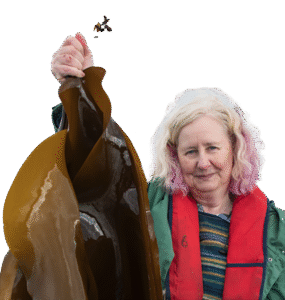
Professor Michele Stanley
Phone
+44 (0)1631 559295
Web address
https://sams.ac.uk/people/researchers/stanley-professor-michele/