By bringing together innovators, healthcare organisations, decision makers and patients to accelerate smart health solution development and overcome long-standing barriers to market, coordinator Alena Bubeck of Steinbeis Europa Zentrum believes the project’s approach will deliver lasting health impacts.
Despite huge progress in AI, data analytics and smart devices, it is clear that digital tools are still nowhere near as embedded in everyday health and care as they could or should be. Many promising technologies remain stuck in labs, pilots or fragmented regional programmes, while innovators and healthcare stakeholders sometimes find it difficult to work together on developing solutions to meet specific needs.
For Alena Bubeck, Project Manager at Steinbeis Europa Zentrum – a long recognised innovation and ecosystem builder for SMEs and research actors in Europe – and coordinator of the SHIFT-HUB project, this gap between innovation and implementation emerged as a critical challenge in the project. A key aim for the consortium was, therefore, to find ways to close the gap, bring stakeholders together and to get innovative digital solutions out of the development stage and into real-world use.
“The idea is really about bringing smart health innovation to people,” she explains. “Along the development chain, there are a lot of stakeholders involved, and many people need to be brought together to make sure innovations actually reach end users.”
SHIFT-HUB, funded under the Horizon Europe programme, is doing exactly that: building a pan-European Smart Health Innovation Hub that brings together healthcare providers, patients, SMEs, researchers, investors, public authorities and other actors to co-develop and adopt smart health technologies.
Why we need a smart health hub
The health challenges SHIFT-HUB set out to address when it started three years ago are not new. They have been with us for many years and they remain among the most persistent pressures on Europe’s health systems. As Bubeck explains, the project was framed around the major health challenges: the rising incidence of non-communicable diseases such as chronic diseases, cancer, cardiovascular conditions, but also the need for disease prevention.
“Prevention is critical, but is often overlooked. It’s often the least attractive topic, even though it has the biggest potential impact,” she says. “Prevention starts with end-users – clinicians, citizens and patients – but human nature gets in the way – because when there is no direct pain point, people rarely act on it. If you’re not sick, you don’t think about preventing illness.”
Smart health applications could help change that equation, using data, decision support and personalised feedback to nudge people towards healthier behaviours and earlier interventions. Yet too many promising tools never make it past the prototype or pilot phase.
When Bubeck and her colleagues looked at why this is the case, one problem appeared everywhere: fragmentation. “Ecosystems differ in maturity, infrastructure, stakeholder types, barriers,” she explains. “Our idea was to overcome this by creating a Europe-wide hub that connects fragmented ecosystems, providing a contact point where they can build communities, share ideas and data and collaborate across borders.
From EDIH principles to a living knowledge hub
SHIFT-HUB does not start from scratch in developing this hub. It builds on the European Digital Innovation Hub (EDIH) concept – physical and virtual one-stop shops that provide digitalisation services to industry and the public sector.
“We are aligned with the structure of innovation hubs like the EDIHs,” says Bubeck. These provide services to stakeholders within innovation ecosystems, but SHIFT-HUB pushes the idea further across regional borders. SHIFT-HUBs aim is to build and connect the Smart Health Community across Europe in one place.
Rather than being another service provider, SHIFT-HUB acts as a knowledge hub and facilitator, helping innovators navigate a complex maze of stakeholders, regulations, data and funding opportunities across European borders. “We want to be the contact point for Smart Health innovators offering a comprehensive portfolio and say: ‘Here is what we can do depending on your stage, how can we help and who we can connect you with?’,” says Burbeck.
As a researcher herself, Bubeck knows how easy it is to get stuck in the lab: “You believe in your innovation, focus intensely on the small steps, and sometimes loose track of the big picture. Later, all the aspects you didn’t consider can become overwhelming, and motivation drops. Innovations then stall. SHIFT-HUB aims to support this whole journey so that doesn’t happen.”


Project Title:
SHIFT-HUB – Smart Health Innovation & Future Technologies Hub
Project Objective:
SHIFT-HUB aims to create a pan-European Smart Health Innovation Hub fostering collaboration among quadruple helix stakeholders. It drives technology development, uptake, awareness, and trust through community building, data sharing, demonstrations, education, and gamified experiences, while ensuring sustainability via policy activities and peer partnerships—paving the way for proactive, personalized healthcare.
Project Duration and Timing:
3 years, January 2023 until December 2025
Project Funding:
European Commission, Horizon Europe, Coordination Support Action, €1,999,999.00

Project Partners:
Steinbeis Europa Zentrum
KiNNO Innovation Intermediaries Ltd
University of Porto
University Hospital Cologne
Aristotle University of Thessaloniki
European DIGITAL SME Alliance
IPPOCRATE AS
BOOSTER Labs S.A.S
BEIA Consult International SRL
Coalition of Organisations patients with chronic diseases in Romania
Cleyrop
Numih France
Mapping the landscape
Turning that ambition into something concrete started from the beginning of the project. “In the concept design phase we mapped existing hubs and facilities to understand what already works,” Bubeck explains. “We didn’t want to reinvent the wheel, so we reviewed existing service structures in other digital innovation hubs and performed a thorough stakeholder mapping to better understand the needs of all stakeholders.”
This led to an initial portfolio built around three types of services:
Involvement services – community building, engagement, facilitation
Growth services – support for SMEs, startups and tech providers
Route-to-market services – access to funding, demonstration, test-before-investment
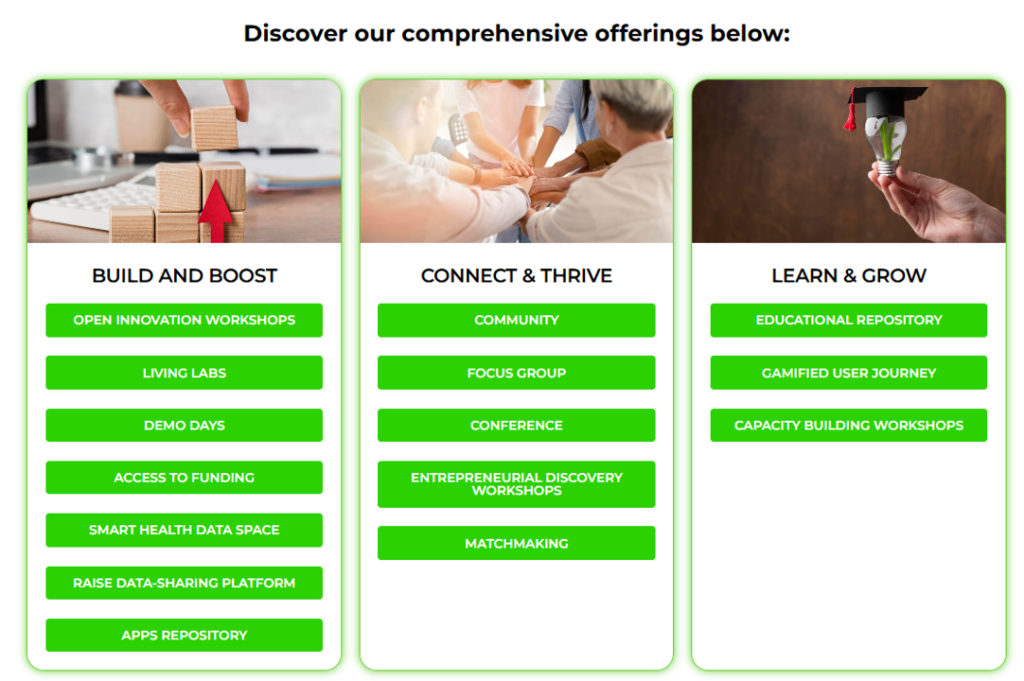
Different stakeholder groups, from innovation hubs and public authorities to tech providers, clinicians, patients and policymakers, were brought into co-design sessions. Over time, feedback led to the fine-tuning of the concept further. “Through multi-stakeholder co-design, we reorganised the services into three clearer pillars,” says Bubeck. These, which now define how SHIFT-HUB works day to day, are labelled: Build & Boost, Connect & Thrive, and Learn & Grow.
Pillar 1: Build & Boost – helping innovations grow
The first pillar, Build & Boost, is focused on the innovators themselves: tech providers, SMEs and startups working on smart health solutions. Services under this pillar aims to helping technology providers and startups develop and co-create solutions, from idea generation to near-market readiness. Services include:
Open Innovation Workshops – where multidisciplinary stakeholders co-create new ideas around healthcare challenges
Matchmaking and Brokerage Events – finding the right partners for R&D, pilots or scale-up
Pitch Sessions and Access-to-finance Support – helping teams refine their proposition and connect with investors or funding schemes
Demo Days – showcasing mature solutions to healthcare organisations, patients and other potential users
The impact is already tangible: SHIFT-HUB has run nine Open Innovation workshops involving more than 400 participants, generating more than 40 concrete ideas. Eighteen of these have led to the building of consortia applying for calls, together requesting more than €15 million.
Pillar 2: Connect & Thrive – a European smart health community
If Build & Boost is about nurturing individual innovations, Connect & Thrive is about building the ecosystem around them. The pillar aims to foster collaboration and build a European smart health community. At its heart is SHIFT-HUB’s community platform – an online space where members can register for free, host events, advertise services and connect with. The platform offers:
Matchmaking and networking
Direct messaging without sharing personal contact details
A marketplace where members can list available services, infrastructure (such as Living Labs), or collaboration offers
Event promotion, and hosting
“Currently our community platform has more than 700 members, and within our project, we have counted more than 730 matchmaking opportunities, with more than 300 effective collaborations,” says Bubeck. “It really shows that people are using the platform to reach out to one another.”
The Connect & Thrive pillar also brings the ecosystem together through a series of structured activities. SHIFT-HUB’s international conferences – hybrid and on-site events featuring policymakers, regional authorities, clinicians, innovators, researchers and citizens – create spaces where different stakeholders of the health innovation system can openly exchange perspectives. Alongside these, the project runs a focus group on priority eHealth topics such as AI in healthcare, data security, secure data sharing, European Health Data Spaces(EHDS) and cybersecurity. This group allow experts to compare approaches, identify gaps and work towards shared policy recommendations.
A third strand, the Entrepreneurial Discovery Workshops, digs deeper at the regional level. Held in places like Central Macedonia, Northern Portugal and Southwest Germany, these sessions bring all ecosystem stakeholders together to map their local structures, needs and barriers, and to co-design the policy recommendations that might help address these.
This policy aspect of the project has been a key component, yet when the findings have been compared, a striking familiarity has become apparent. As Bubeck puts it: “Looking at the policy recommendations that have emerged from the workshops, there are none that you have never heard of, which is actually quite shocking as it shows they have not been addressed fully over many years. We seem to be talking about these things over and over again, but not acting.”
The persistent obstacles that SHIFT-HUB has found resurfacing in the policy recommendations are: early-stage funding gaps, the familiar ‘valley of death’ for startups, insufficient and inconsistent mentoring networks, and an urgent need for interoperable health data infrastructures capable of supporting digital innovation at scale.
Pillar 3: Learn & Grow – literacy, trust and capacity
This third pillar addresses another critical barrier, knowledge and trust, by supporting knowledge exchange and capacity building across different stakeholder groups. Its flagship output is an educational resources catalogue – almost 190 resources across 15 themes such as AI, data science, smart health applications and training formats.
The catalogue targets patients, citizens and healthcare professionals and aims to build trust and improve digital literacy, which are essential for data sharing and the uptake of digital solutions. Importantly, it will remain freely accessible via the SHIFT-HUB website even after the project ends – and for Bubeck, this is fundamental. “We were also lucky that our SHIFT-HUB partner, the University of Porto, who lead the development of the catalogue, secured follow-up funding via the INNOV4LIFE Interreg-project, which will continue to update the educational resources available,”she says.
“Building trust is essential – patients and citizens need to know their data is being handled correctly and securely. Without that trust, they won’t share their data, and without data, smart health solutions simply cannot be developed. These technologies depend on it.”
The involvement of COPAC, the Coalition of Organisations of Patients with Chronic Diseases in Romania, as a patient organisation and project partner has also been crucial in this aspect of the project. Their networks give SHIFT-HUB fast access to large groups of patients and carers for feedback, co-design and testing. “Having patients or patient representatives included in European funded projects is essential,” says Bubeck. “Our main goal is to help people with these solutions. But in order for them to use them, they need to accept and trust them. Therefore, it is important to involve patients from the get go and listen to their feedback. This allows us to do that. In fact, I would probably never plan another European health project without having a patient representative organisation involved. “
Real-world testing
Beyond frameworks and platforms, SHIFT-HUB has also generated concrete results. Alongside the Open Innovation workshops and consortia, the project has organised five Living Labs with more than 200 participants – patients, citizens and healthcare professionals – all testing solutions on topics like health literacy for seniors, frailty prevention and digital health training.
For more mature solutions, SHIFT-HUB has run six Demo Days with more than 300 participants and around 20 startups. One standout is MedRadar, an app that helps patients locate pharmacies that have specific medicines in stock, providing a clear example of how SHIFT-HUB is already helping to turn ideas into solutions on the market.
“Our event helped MedRadar speed up their journey from idea to market solution,” says Bubeck. “They now have more than 20,000 users and 2,500 pharmacies that are listed and using the app, which is very encouraging.”
At the same time, more structural initiatives have emerged, such as a Living Lab being set up in Bucharest by COPAC with the local medical university.
Lessons learned
Among the most revealing outcomes of SHIFT-HUB’s work are the insights it has gathered on Europe’s investment culture. Despite the abundance of smart health ideas emerging across the continent, many struggle to progress beyond early stages, not because of a lack of creativity or market viability, but because of an over-cautious investment culture.
As Bubeck explains, investor feedback was surprisingly consistent: “They agreed that the innovation ecosystem in Europe will often not take too many risks, so we are holding ourselves back a bit. But this risk aversion is compounded by bureaucracy, regulatory complexity and fragmented national frameworks, all of which make market entry even harder,” she reports.
The absence of a unified European pathway, particularly for regulatory and data-related requirements, leaves innovators navigating a patchwork of systems at the very moment they most need clarity. For the experts, part of the solution here lies in embracing a more experimental mindset. Europe, they suggest, must become more comfortable with iteration, rapid decision-making and letting go of innovations that aren’t working.
It seems this is precisely where SHIFT-HUB can add value. By bringing innovators together with reviewers, investors, patients and other stakeholders early in the process, the hub helps make those difficult decisions clearer and less costly.
“We need to connect the innovators with the end users, the investors and the entrepreneurs that have gone through all of these stages, to provide critical feedback,” Bubeck continues.
Through its pitch programmes, brokerage events, Living Labs and multi-stakeholder workshops, SHIFT-HUB creates the spaces where that candid feedback can happen. In doing so, it helps de-risk innovation not by eliminating uncertainty, but by ensuring that innovators have the information, insight and connections they need to deal with bureaucracy and regulations and to make informed decisions faster.
Growing the hub
Despite the project coming to an end, Bubeck is refreshingly realistic about its longevity and for the hub to keep delivering. On the business side, ideally they would love to establish an innovation cluster that is independent of public funding, but the likelihood is that more public funding will be needed. The team is, therefore, actively seeking follow-up funding to evolve into a fully funded European innovation hub or join forces with other related innovation ecosystems.
In the meantime, all SHIFT-HUB partners are dedicated to keeping the services alive and accessible. The community platform will remain open for at least five years, replication and best-practice sheets are being prepared for all services and partners have committed to being reachable as contact points.
On the topic side, one of the most promising growth areas now is secure health data sharing. Rather than building its own platform, SHIFT-HUB has chosen to collaborate with the RAISE project, an EOSC project, which is piloting data sharing infrastructure aligned with the future European Health Data Space.
“There is no point in replicating it,” Bubeck says. “Instead, our role will be to make sure our community knows that such a platform exists and can use it, especially technology providers and entrepreneurs who can access available datasets to test their ideas and trial their prototypes.”
As SHIFT-HUB transitions beyond its funded period, and with much of its activity continuing, the project has also already left a durable legacy, at the centre of which is the community platform, which Bubeck describes as essential for bringing diverse stakeholders together for the marketplace and the matchmaking opportunities.
Around this sits a set of practical tools and methods that will also outlive the project: structured approaches for Demo Days, test-before-investment activities, and Capacity-Building Workshops; the project’s targeted value-creation methods that help other innovation hubs evaluate and strengthen their own services; and the educational resources catalogue, which consolidates smart-health training materials in one accessible place. Equally important is the growing network of collaborating hubs and innovation intermediaries now able to guide innovators across regions and sectors.
Of course, no one expected a three-year project to remake Europe’s innovation landscape, but Bubeck is clear that SHIFT-HUB has shifted the ground in this time: “The project has created a space where European smart health innovation is likely to be more effective, and to thrive more than it was before the project happened, particularly in partner regions and countries such as Portugal, Central Macedonia and Romania,” she says.
“I see SHIFT-HUB as a real contact and connection point; a valuable community. It’s not just about offering services, but about being the place people can turn to whenever they need support.”
For innovators, healthcare providers, patients, authorities and investors across Europe, the message is straightforward: Join this community, use the services, bring your challenges and your skills and help co-create the digital health solutions Europe urgently needs.
Visit https://shift-hub.eu/ for information about joining the hub and gaining access to more than 700 members in the community.