

Manufacturing in Europe is in a tricky spot. Increased global competition has meant that companies are desperate to take advantage of any technology that might give them an edge. The dawn of agile production, based on technologies such as the Internet of Things, human-robot collaboration, augmented reality, and artificial intelligence, offers huge potential benefits to manufacturers, and many larger firms with hefty R&D budgets have already taken the plunge.
But what about the thousands of manufacturing SMEs in Europe? Although agile manufacturing would undoubtedly benefit them, many companies of this size simply lack the resources and skills needed to effectively implement it. Knowing what problems can be solved, what technology to pick and how to approach the integration of such solutions are all essential if an SME is to survive in global competition alongside bigger players.
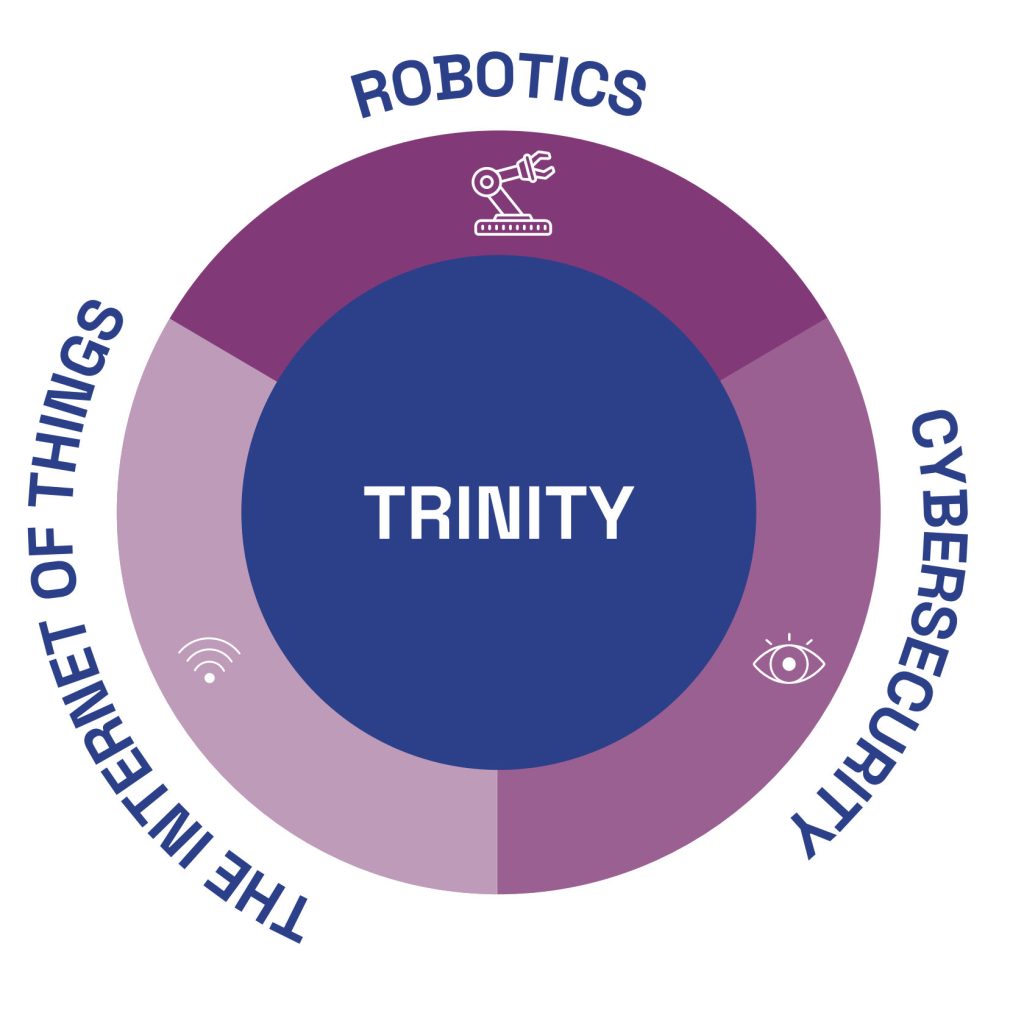
The TRINITY project is a €16 million Horizon 2020 project that is facilitating European SMEs in engaging with agile manufacturing by helping them to implement advanced robotics solutions. This is being done via a network of multidisciplinary digital innovation hubs composed of research centres, companies, and university groups that have expertise in different areas of agile production. Digital tools, data privacy and cybersecurity technologies are also introduced to support the robotic solutions.
Project manager Jyrki Latokartano explains the thinking behind the project. “The robotic solutions we provide can help SMEs improve their production processes and product quality by carrying out mundane, repetitive, and dangerous tasks,” he says. “On top of this, we implement ICT and AI solutions to shorten the overall production time, as well as cybersecurity measures to ensure that the robotic work cells cannot be hacked Finally, the digital innovation hubs we have set up in the Trinity network provide one-stop shops that offer continued support to SMEs across Europe, no matter what stage they are at in their journey towards agile manufacturing.”
To help engage SMEs in the concept of agile manufacturing, the project has created a catalogue of use cases and technical modules that demonstrate the areas of robotics identified as the most promising for advancing agile production. These include collaborative robotics systems with sensory systems to ensure safety, user interfaces based on augmented reality and speech, and reconfigurable robot work cells, to name just a few.
With the demonstrators in place, TRINITY has run two rounds of open calls for application experiments, where companies with agile production needs and sound business plans have been supported by the Trinity project’s digital innovation hubs to advance their manufacturing processes. From over 200 applications, 37 were selected and funded (total budget €8.1 million). As well as providing technology-centred services through laboratories with advanced robot technologies and know-how, the digital innovation hubs also offered training and consulting services, including support for business planning and access to financing. Another important activity of the project will be the preparation of a business plan to sustain the network after the end of the project funding.
Most of the technical modules and use cases in TRINITY are the results of previous EU projects. “A lot of EU money has been used to develop these agile manufacturing technologies, but they have suffered from not being marketed, with the result being that most manufacturers don’t know about them,” says Latokartano. “An important lesson we have learned is that many technologies that we have thought would translate brilliantly to SMEs are way beyond their level of understanding, so we have put a lot of effort into packaging them up into easily understandable forms.
“Our funding has required us to work between TRL 5-7, but for many end users, even TRL 7 is too difficult to implement. Finding skilled enough SMEs to work at the level of TRINITY has been a challenge for us, which really demonstrates the gap that still exists between industry and academia in the field of agile manufacturing. These technologies represent a huge potential for many European SMEs to improve the way they do business, and I hope this project can encourage more of them to take the leap.”

Project Title:
TRINITY – Digital Technologies, Advanced Robotics and increased Cyber-security for Agile Production in Future European Manufacturing Ecosystems
Project Objective:
The main objective of TRINITY is to create a network of multidisciplinary and synergistic local digital innovation hubs (DIHs) composed of research centers, companies, and university groups that cover a wide range of topics that can contribute to agile production: advanced robotics as the driving force and digital tools, data privacy and cyber security technologies to support the introduction of advanced robotic systems in the production processes.
Project Duration and Timing:
52 months
January 2019 – June 2023
Project Funding:
EC Funding: €15.99 million
Project Partners:
- Tampere University
- Fraunhofer IWU
- LSEC
- Flanders MAKE
- CECIMO
- EDI
- BME
- LMS
- Jozef Stefan Institute
- UiT
- CENTRIA
- Digital Norway
- CIVITTA
- Fastems
- LP
- F6S
AGILE: Advanced robotics solutions for increasing the agility of the automotive cable production industry
Portuguese company Allbesmart has identified a market opportunity related to the emergent modernisation of the automotive cable assembly industry. Traditionally, this industry depends on manual work, but recently there has been a push for the introduction of robotics. These robots, however, are not fully autonomous, as there is still a need for human intervention.
The AGILE experiment has allowed Allbesmart to pursue this business opportunity, acting as an augmented reality (AR) technology provider for industrial robotics solutions. Acknowledging this sector’s innovation potential, a huge potential exists to scale up quickly since several companies in the cable assembly sector are already looking for solutions to improve maintenance services and extend machine operation lifetime. Allbesmart is already taking advantage of the existing cable industry ecosystem in the inner region of mainland Portugal, to test and promote AR technology to support machine operators and maintenance technicians.
With the AGILE AR application, machine operators/technicians have facilitated access to machine information through the AR interface. This information includes general machine information, maintenance information, and machine performance data. Workers can also consult machine schematics (electrical and pneumatic), receive on-site training (step-by-step guides which may include video tutorials), visualise machine alerts and understand how to fix them, and even control specific parts of the machine through the AR interface.

The demonstrator developed in TRINITY produced a 50 per cent decrease in the average time required to train a maintenance technician to correctly perform an unfamiliar or new maintenance operation, and reduced the maintenance operations costs by up to 70 per cent.
The availability of funds to support R&D activities was critical to decreasing the business risk associated with the adoption and acceptance of the training-on-the job AR technology. The integration of TRINITY software modules in the innovative robotic solutions developed by the AGILE consortium was instrumental to its success. Moreover, the feedback obtained from the TRINITY mentors was essential for fine-tuning the usability of the AR application.
VisDeburr: Fast and reliable solution for cleaning burrs
A burr is a raised edge or small piece of material that remains attached to a workpiece after a modification process. It is usually an unwanted piece of material and is removed with a deburring tool in a process called ‘deburring’. Burrs are most commonly created by machining operations, such as grinding, drilling, milling, engraving or turning.
Although previously a job done by humans, decreasing appetite among young people for such employment has caused automated robots to take over the task. Although robots have now been used for deburring for decades, they complete the task in an inflexible way that assumes that each burr is the same. Looking to improve this process, Finnish metalworking SME Elektrorakenne approached software company Convergent Information Technologies to work on a solution that could react more flexibly to different sizes and dimensions of burrs.
Convergent Information Technologies brought two approaches to this problem. Firstly, they provided 3D simulations and modelling software that allow the user to quickly and easily guide the robot and programme how it should clean the burrs. Secondly, they used machine vision via a laser scanner to measure the size of the burrs, enabling the robot to tailor its cleaning process for each specific burr.

TRINITY has been a key part of this work, as Mikko Sallinen of Convergent Information Technologies explains: “Creating a solution like this requires a development process that involves a lot of trial and error and testing. TRINTY was an excellent platform for us to work together with the end users, Elektrorakenne, and a systems integration compant called Flexido, to develop a new product, as it provided support for the risk that is inherent in such an endeavour.
“The setup of the TRINITY projects, which last just six months and are targeted to solve very specific problems, is also much better suited to SMEs than larger EU research projects, which may be good for more fundamental research, but are not a good fit when your outlook is not as long term.”
