

For decades, modern healthcare has relied on a centralised model of diagnostics. When illness strikes, patients often travel to hospitals or clinics, where samples are collected and processed in specialist facilities before results are returned hours or even days later. It is a system that has delivered remarkable advances in clinical accuracy and disease detection, but it is also built around controlled environments, fixed infrastructure and predictable demand. When rapidly evolving global health emergencies strike, these models can be tested to breaking point.
The COVID-19 pandemic exposed these limitations with unprecedented clarity. Systems designed for stability were suddenly required to operate at global scale, under pressure and in real time. “COVID showcased the fact that we could not reach reliable, effective and inexpensive diagnostics quickly enough,” says Stamatiki Kritas, Managing Director of CEBR and Cluster Manager of the Hellenic BioCluster and the UniHealth project’s dissemination lead. “We couldn’t manage the crisis in the usual way, in one hospital or as one country. We needed to look at it collectively, globally and we were not set up for that.”
For Professor Electra Gizeli, coordinator of UniHealth and Group Leader at the Institute of Molecular Biology and Biotechnology (IMBB) at FORTH, the pandemic brought into sharp focus many of the challenges she has spent years trying to address. “When the pandemic came, the world was not prepared,” she reflects. “Not just in diagnosing the virus, but in providing drugs, delivering devices, monitoring the spread through surveillance-tools and managing the whole pipeline; we were simply not prepared for what we faced.”
These systemic weaknesses highlighted a more specific challenge: the gap between scientific capability and practical readiness. “We realised that health threats can come again and so we have to be better prepared.”
This gap between technological capability and real-world delivery is the starting point for this project. UniHealth is a European research initiative focused on the development of molecular diagnostic solutions that are based on the detection of genetic biomarkers; molecular diagnostics outperform the standard antibody/antigen rapid tests by detecting directly the nucleic acid of the virus upon enzymatic amplification. As a result, several million nucleic acids can be produced that are identical to the viral RNA, starting from just a few copies of the virus in the patient’s sample. The detection of the genetic material is a laboratory-based method, requiring the use of several dedicated instruments.
However, one of the current challenges is the ability to perform the same test in an environment outside the lab, at the point-of-care, with equal sensitivity and reliability, offering, in addition, portability, fast results, simplicity in operation and low cost. UniHealth’s aim is to deliver a broad range of molecular diagnostic solutions for point-of-care applications, with a focus on detecting emerging pathogens.
“We don’t want the next pandemic to find us again unprepared,” says Gizeli. “Let’s face the challenge of being able to deliver fast diagnostic solutions at the beginning of the next outbreak. We should have already investigated and figured out which methods are the best depending on the pathogen and sample, how fast we can prepare them, and how best they can be deployed to slow down the spread of disease.”
Distributed solutions
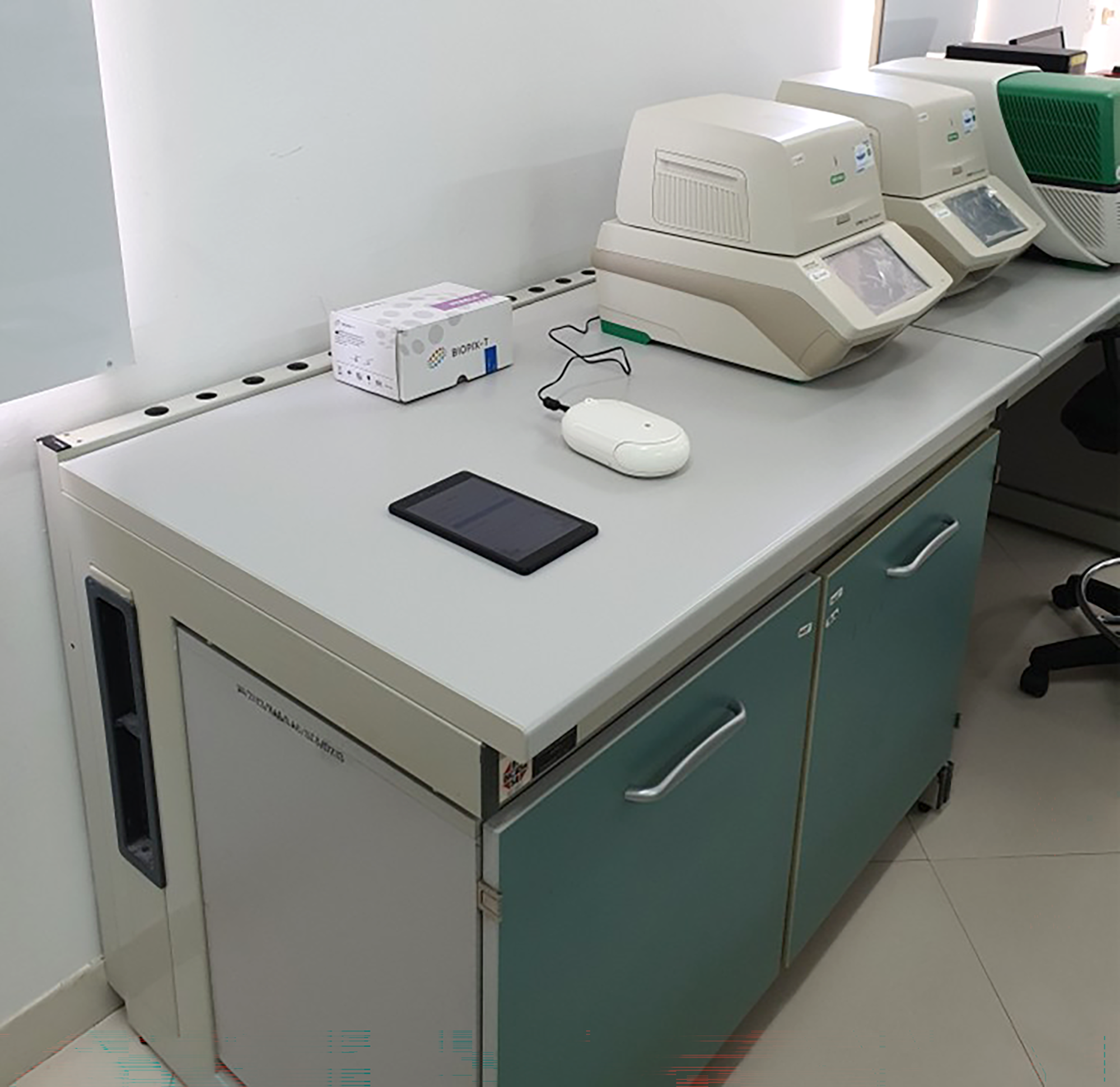
At the centre of the UniHealth approach is a portable diagnostic platform, building on technology developed by SME partner BIOPIX DNA Technology, a spin-out from FORTH. “The initial idea is based on the PEBBLE device,” explains Dr. Anastasia Galanopoulou, Scientific Manager of UniHealth. “It’s a smart portable device that can be used for molecular diagnostics at the point of care.”
In practical terms, the system brings laboratory-level testing into a compact, self-contained unit. Using isothermal amplification techniques, it can detect viral or bacterial genetic material directly from patient samples without the need for complex laboratory infrastructure or time-consuming preparation steps. The process itself is designed to be simple and fast. A sample is mixed with reagents and placed into the device, where it is heated to enable the reaction to take place while an integrated optical system monitors changes in real time. Normally, in 30-40min, a result is available.
Crucially, the system is designed not just for portability, but for connectivity and immediacy. “It can be inexpensive, rapid and connected,” says Galanopoulou. “It can connect the data to a server instantly, so you don’t have to wait for the outcome from centralised laboratories, which usually takes a lot of time.”
This combination of speed, simplicity and connectivity underpins a different model of diagnostics, one that removes delays between testing and decision-making and enables results to be generated and shared wherever the patient happens to be.
The importance of this shift lies in the role diagnostics play in the broader healthcare pathway. Delays in testing can directly affect how quickly diseases are identified, contained and treated. By moving diagnostics closer to the point of care, UniHealth shortens that chain.
Designing for the unknown
If decentralisation addresses the limitations of current systems, UniHealth’s focus on adaptability addresses the uncertainty of future threats. One of the defining challenges in diagnostics is not only detecting known diseases but responding rapidly to new ones. Each emerging pathogen typically requires the development of new assays, protocols and validation processes, a process that takes time and limits how quickly health systems can respond.
“What we are trying to do is advance this technology so that it is ready for the next pandemic,” says Galanopoulou. “At the moment, you need time to develop new protocols for different targets and different matrices – human samples, mosquito samples and environmental samples, for example. Under UniHealth, we are creating ,. pipelines that can be adapted instantly.”
For Gizeli, preparedness is not an abstract hope; it is a measurable scientific objective. “It means that when the next health threat appears, we should be able to rely on already developed and mature solutions which can be deployed to the end user very fast, ideally within less than a month, relying on a fast certification route,” she explains. “Before, it took us 18 months to prepare and deliver our first innovative molecular diagnostic solution. Reducing this time to one month would be a huge improvement and a huge step forward.
“To achieve a fast response, we cannot rely on rapid innovation in the moment of crisis,” she continues. “It depends on systematic and collaborative work carried out in advance. We need validated methods, tested systems and reliable processes developed in collaboration with all stakeholders – researchers, engineers, clinicians, certification consultants, entrepreneurs and end users.
“We cannot start research at the next moment of crisis. We need technologies that are already in the lab and have been validated and accepted by clinicians and end users.”
Central to this is the idea of a pipeline – a structured, repeatable process that allows new diagnostic tests to be designed and deployed as soon as an emerging pathogen is identified. “Once we know the genome sequence, we can deliver the test”, Gizeli says. “Because we have already done the steps. We know which methods work, which samples they work with. We are investigating each case and collecting this important information in advance.”
In practice, this means creating standardised workflows that connect bioinformatic data, assay design and device integration into a coherent system. Instead of starting from scratch whenever a new pathogen emerges, researchers can adapt and deploy existing processes, dramatically reducing development time.
The approach also reflects a broader understanding of how diseases emerge and spread. UniHealth is grounded in the One Health perspective. This is a concept that recognises that human health, animal health and environmental conditions are closely connected, and that emerging threats often move between these domains. “We want to be able to rapidly develop assays to detect novel diseases, not only for humans, but also for animals and the environment,” says Galanopoulou. “Because these are all interconnected.”
By integrating this perspective into its design, UniHealth extends the role of diagnostics beyond clinical settings, enabling earlier detection of threats wherever they originate.
From vision to application
For Gizeli, this is not simply about improving speed or efficiency. It is about fundamentally changing how diagnostics are used. Rather than being confined to laboratories and triggered only once symptoms appear, diagnostics should become more immediate, more accessible and more closely integrated into everyday healthcare. “We need to give the doctors, patients and all end-users the ability to manage their health or just to know whether they’re healthy or not,” she explains.
“Uncertainty has real consequences in any pandemic. Without timely, reliable diagnostics, people are forced to make decisions based on incomplete information, increasing the risk of transmission and delaying intervention.”
UniHealth addresses this challenge by bringing rapid, accurate testing closer to the point of need. “We are creating tools that allow people to act quickly and appropriately, supported by reliable information,” Gizeli continues. “Our vision is to have solutions that are ready before any new pandemic arrives and technologies that can operate reliably beyond the laboratory, in the everyday settings where decisions are made and where early intervention matters most.”
Speed and sensitivity
A critical challenge in moving diagnostics closer to the patient is maintaining the balance between speed and accuracy. “From COVID, we know that there are two different technologies that we all use,” says Galanopoulou. “On the one hand, there are antigen-based tests, which are inexpensive and very rapid. On the other hand, there are highly sensitive molecular diagnostics in centralised laboratories, which are very expensive.
“We want an approachable diagnostic tool that can be performed as easily as the rapid antigen test that we buy from the pharmacy, but which has the sensitivity of the assays that take place in centralised laboratories.”
This ability to deliver laboratory-level performance in a portable format is central to the project’s impact, ensuring that decentralisation does not come at the expense of reliability.


Project Title:
UniHealth: Development of a diagnostic ecosystem for detecting and monitoring emergency-prone pathogens across species, globally and in a unified way.
Project Objective:
UniHealth is developing accessible point-of-care diagnostics for emerging pathogens, supporting pandemic preparedness through a One Health approach.
Project Duration and Timing:
36-months. Timing: 1 December 2023 – 31 May 2027
Project Funding:
Funded by the EU under the Horizon Europe Health programme. Total cost €5,345,960.00/ EU contribution €4,887,345.13.

Project Partners:
Coordinator
Foundation for Research & Technology, Hellas — Greece
Participants
BIOPIX-T — Greece
CHARITE – UNIVERSITAETSMEDIZIN BERLIN — Germany
INSTITUT PASTEUR DE TUNIS — Tunisia
INSTITUT PASTEUR — France
HARALDSPLASS DIAKONALE SYKEHUS AS — Norway; KIARA HEALTH (PTY) LTD — South Africa
UNIVERSITETET I BERGEN — Norway; Hellenic Bio Cluster (HBio) — Greece
Partner organisations
PKNM SOLUTIONS SARL — Switzerland
UNIVERSITY COLLEGE LONDON HOSPITALS NHS FOUNDATION TRUST — United Kingdom
Population insight
While the immediate benefit of point-of-care diagnostics is faster individual testing, the broader impact lies in how data is generated and used. “Surveillance is crucial, not only to know who is sick, but also for prediction models,” says Galanopoulou.
Traditional testing models tend to capture only those who actively seek testing, introducing bias into the data. Distributed diagnostics offer a different perspective. “With portable testing, devices can be used in airports or on public transport, for example,” she explains. “This provides a more representative view of the population and opens up new possibilities for real-time monitoring and early detection.”
This ability to generate data closer to where people live, work and travel could significantly improve preparedness. “If you know where you’re at, you can respond,” adds Kritas. “That’s why it is called preparedness.”
Real-world deployment
Unlike many research initiatives, UniHealth builds on an existing commercial foundation. BIOPIX DNA TECHNOLOGY SME partner has already launched diagnostic products for COVID-19 and influenza using the same underlying technology. This has allowed the project to focus not only on innovation, but on scaling up and expansion – extending the platform to new diseases, new markets and new healthcare environments. “The commercial entity is already there,” says Kritas. “What we are trying to do now is add value to the products they already have, create new products and enter the market quicker.”
For Gizeli, however, entrepreneurship has never been about commercialisation for its own sake. She is now focused on the impact this commercial technology can deliver. “Challenge-driven research has always been of particular interest to me,” she says. “In my group we are continuously striving to adapt new scientific concepts and innovations to solve global problems. We are passionate about translating laboratory results to useful solutions for society.
“It is no good to do all this work and just leave it there. It is not fair for the researchers involved, the funding body and society as a whole. I have always felt it my obligation to go beyond the lab, translate the results and deliver a solution. When you see that there are results with exploitation potential, it is inspiring to move forward, write a patent and ideally give it to the people who can develop it,” she explains. “Otherwise, important work can stay in the lab as internal knowhow; beyond publishing, it is of paramount importance to reach the people who can benefit from this work.
“BioPix, a FORTH spin out, is a perfect example of technology transfer. This is what I mean by delivering useful solutions – BioPix IP and technological solutions are now making a real difference in POC diagnostics, from Africa to Europe and the US.”
Accessibility and equity
At the same time, the project is tackling the challenge of global accessibility by supporting regional production capabilities. “We want production to be autonomous in every region,” says Galanopoulou. “Not only in Europe, but also in underserved communities, including Africa.”
This ambition reflects a broader understanding of what it takes to make diagnostic innovation truly accessible. “The technology is simple in the sense it can be produced easily,” explains Gizeli. “It does not require sophisticated parts or manufacturing methods thanks to the novel detection methodology we are employing. Manufacturing can take place in Europe, Africa or anywhere else in the world as long as there is a 3D printer and a computer.
“We want everyone to have access to powerful and robust technologies wherever they are based,” she adds, and for her that means going beyond practicality. It is her guiding principle. “I am not so keen on technologies that are suitable only for one part of the world,” she says. “I prefer to develop technologies that can have a large impact and be applied globally, equitably.”
Collaboration
Making this vision a reality requires much more than technological excellence.
“To bring a product to the market, you need a lot of different people with different expertise,” says Kritas. “Researchers, clinicians, commercial partners, regulatory experts.”
This multidisciplinary approach ensures that innovation is translated into solutions that function in real-world settings and across different healthcare systems. It also extends beyond traditional stakeholders to include the people who will ultimately use the technology. “The end users co-shape the final product with us,” explains Galanopoulou. “We take into consideration their feedback, whether it is easy to use, whether they trust the technology, to make the product more user- and society-friendly.”
A new diagnostic paradigm
Taken together, these elements point towards a broader transformation in healthcare – one in which diagnostics are no longer centralised and reactive, but embedded in everyday life. “I think in 15 years, most things will be next to the patient,” says Kritas. “We give patients their dignity, their quality of life and we can deliver diagnosis and treatment where they are.”
For Galanopoulou, the long-term implications extend well beyond pandemic preparedness. “This technology will become a standard technology for point-of-care testing,” she says. “It will also be useful for other aspects like antimicrobial resistance, food safety and sexually transmitted diseases.”
For Gizeli, however, the future is ultimately about thinking beyond individual technologies and towards the systems they support. “I believe that you always need to think a few years ahead and be several steps ahead,” she says.
UNIHEALTH is not simply developing new diagnostic technologies. It is helping to build the foundations of a more responsive, more equitable and more resilient healthcare system. “We are looking at a very big picture,” says Gizeli. “A full ecosystem.”

Electra Gizeli
Phone
0030 2810 394373
Web address